














How to Specify High-Current Connectors for Industrial Equipment
How to Specify High-Current Connectors for Industrial Equipment
Introduction
As industrial equipment becomes smaller, smarter, and more power-dense, engineers face a growing challenge: how to transmit power reliably without sacrificing installation space, serviceability, or environmental protection.
Traditional high-power connections such as bolted busbars, cable lugs, and screw terminals remain useful in many fixed installations. However, modular industrial equipment increasingly benefits from pluggable connector interfaces that can simplify assembly, replacement, and maintenance.
For engineers researching an M12X High Current Connector, the key is not simply finding the connector with the highest current rating. The correct solution must match the complete operating environment of the machine.
This guide explains how to specify an M12 high-current connector for industrial equipment, what technical parameters matter most, and how CONNODER can support OEMs and industrial automation customers with M12 and other circular connector solutions.
Engineering Note: The term 鈥淢12X鈥� can refer to an M12 X-coded connector, which is commonly associated with high-speed data transmission. X-coded does not automatically mean high-current. When power transmission is the primary requirement, engineers should select the appropriate M12 power coding and verify the connector's actual current and voltage ratings.
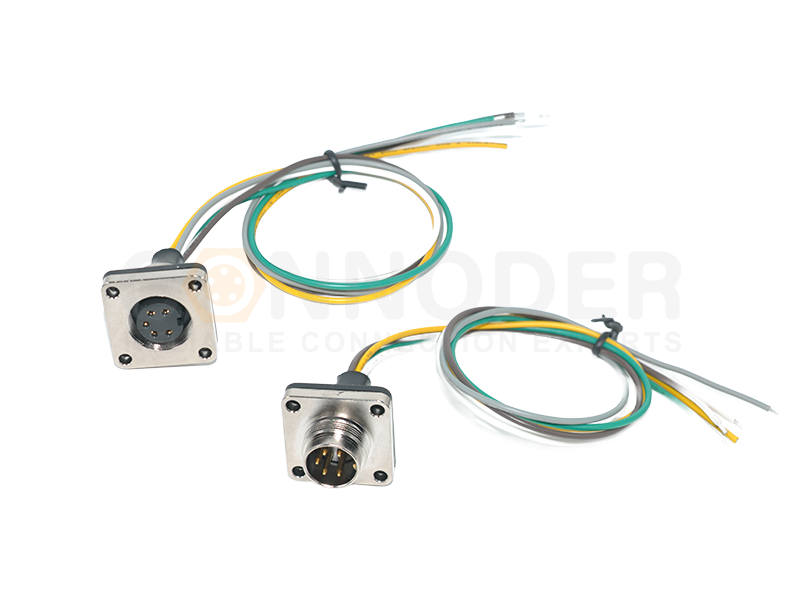
Circular Connectors
Rugged, compact and versatile — ideal when you need mixed power & signal plus environmental protection.
What Is an M12X High Current Connector?
The M12 connector family is widely used in industrial automation because it combines a compact circular form factor with secure mechanical coupling and multiple electrical configurations.
However, M12X should not automatically be interpreted as 鈥渉igh current.鈥�
In the M12 ecosystem, X-coded connectors are commonly associated with high-speed Ethernet/data transmission, while M12 Power solutions use other coding configurations depending on the intended power application.
Therefore, when specifying an M12X High Current Connector, engineers should first clarify whether the project requires:
•High-speed data transmission
•Power transmission
•Power plus signal
•A combination of M12 Ethernet and M12 Power connections
The correct connector should then be selected according to its actual electrical rating and application-specific datasheet, rather than its M12 thread size or coding name alone.
Why High-Current Connector Specification Requires More Than an Amp Rating
A common mistake is to select a connector simply because its catalog current rating appears higher than the equipment's operating current.
A connector's usable current capacity depends on conditions such as:
•Ambient temperature
•Number of energized contacts
•Conductor cross-section
•Contact resistance
•Housing design
•Cable routing
•Airflow
•Installation density
•Duty cycle
•Environmental conditions
Key principle: The highest ampere value in a catalog is not necessarily the best selection. Electrical, thermal, mechanical, environmental and service requirements should be evaluated together.
How to Specify an M12X High Current Connector
1. Define the Actual Current Requirement
The first step is determining how much current the equipment really requires. Do not only record the nominal operating current.
Your specification should distinguish between:
•Continuous current
•Peak current
•Startup current
•Inrush current
•Regenerative current
•Duty cycle
•Number of energized circuits
| Parameter | Requirement |
|---|---|
| Continuous current | Define actual operating value |
| Peak current | Define maximum transient |
| Peak duration | Seconds or minutes |
| Duty cycle | Continuous or intermittent |
| Number of circuits | Define simultaneously energized contacts |
| Ambient temperature | Minimum and maximum |
| Voltage | Nominal and maximum |
| Allowable voltage drop | Application dependent |
Engineering tip: A connector that is technically rated for a particular current under laboratory conditions may require derating when installed in a hot, enclosed industrial cabinet.
2. Specify Operating Voltage Separately
Current and voltage are different electrical design parameters. An M12 connector with adequate current capacity may still be unsuitable if its voltage or insulation characteristics do not satisfy the application.
Specify:
•Nominal voltage
•Maximum voltage
•AC or DC
•Transient voltage
•Clearance
•Creepage
•Insulation material
•Pollution conditions
•Touch protection
•Grounding requirements
3. Evaluate Temperature Rise and Derating
One of the most important considerations for a high-current connector is temperature rise.
Temperature rise can be influenced by:
•Contact resistance
•Contact geometry
•Contact force
•Contact material
•Plating
•Conductor resistance
•Crimp quality
•Ambient temperature
•Cable size
•Enclosure airflow
•Adjacent heat sources
•Contamination
M12 connectors are valued for their compact size, but compact installation can also mean that several connectors are positioned close together. The combination of high current + high ambient temperature + limited airflow + multiple energized connectors requires careful thermal evaluation.
4. Match Cable Size to the Connector
The connector and cable should be specified as a complete electrical path.
Important cable parameters include:
•Conductor material
•Cross-sectional area
•AWG
•Strand class
•Cable flexibility
•Insulation temperature rating
•Outer diameter
•Shielding
•Minimum bending radius
An incorrectly matched conductor and terminal can result in poor crimp compression, reduced pull-out strength, broken strands, increased resistance, localized heating and poor sealing.
5. Select the Correct M12 Coding
This is particularly important when optimizing content around M12X High Current Connector. M12 connectors use different coding systems for different functions.
| M12 Configuration | Typical Application |
|---|---|
| A-coded | Sensors and actuators |
| D-coded | Industrial Ethernet |
| X-coded | High-speed Ethernet/data |
| K-coded | Power applications |
| L-coded | DC power |
| S-coded | AC power |
| T-coded | DC power |
Need an M12 Connector for Your Industrial Equipment?
Share your required current, voltage, cable size, coding, IP rating, temperature range and application environment with CONNODER to discuss a suitable connector configuration.
What is an M12X high current connector?
An M12X high current connector generally refers to an M12 connector considered for applications requiring reliable power or data connectivity in industrial equipment. However, X-coded M12 connectors are primarily associated with high-speed Ethernet and data transmission. For high-current power applications, engineers should select the appropriate M12 Power configuration based on its actual current, voltage, temperature and environmental ratings.
How do you specify a high-current connector for industrial equipment?
To specify a high-current connector, engineers should evaluate continuous current, peak current, operating voltage, cable size, contact resistance, temperature rise, IP rating, vibration, termination method and mating cycles. The connector should be evaluated as part of the complete electrical and mechanical system rather than selected only according to its maximum catalog current rating.
Is an M12 X-coded connector suitable for high-current applications?
Not necessarily. M12 X-coded connectors are commonly used for high-speed industrial Ethernet and data transmission, rather than being defined specifically as high-current power connectors. If the primary requirement is power transmission, an appropriate M12 Power connector should be selected according to the required current, voltage, cable size and environmental conditions.
What factors affect the current rating of an M12 connector?
The effective current capacity of an M12 connector can be affected by contact resistance, conductor size, ambient temperature, number of energized contacts, connector design, cable construction, airflow and duty cycle. Temperature rise and derating should therefore be considered when selecting an M12 connector for high-current industrial equipment.
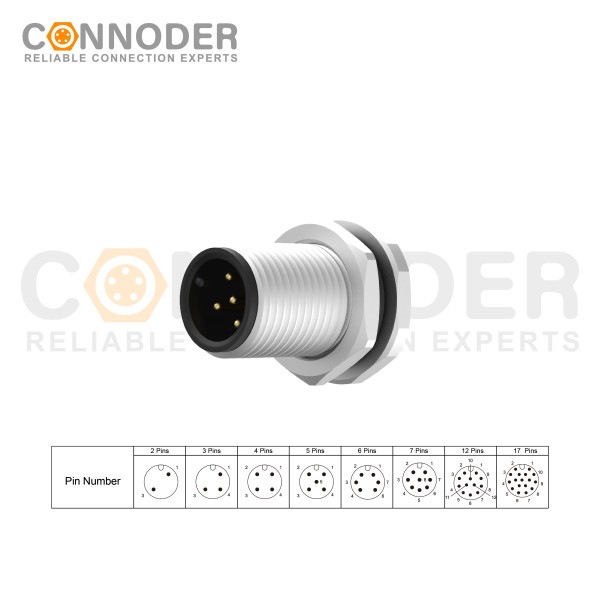
With its compact design and robust construction, M12 A 5 Pin Circular Connector occupies an important position in the field of modern industrial automation.
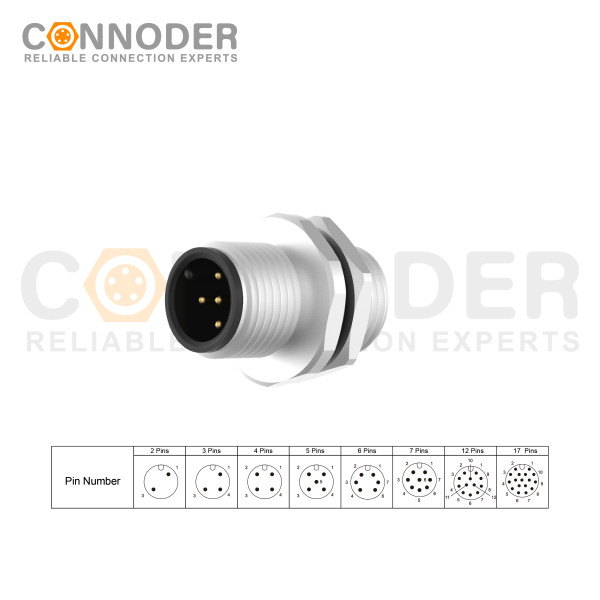
M12 A 5 Pin Circular Connector is a metric circular connector used in industrial automation and other harsh environments.
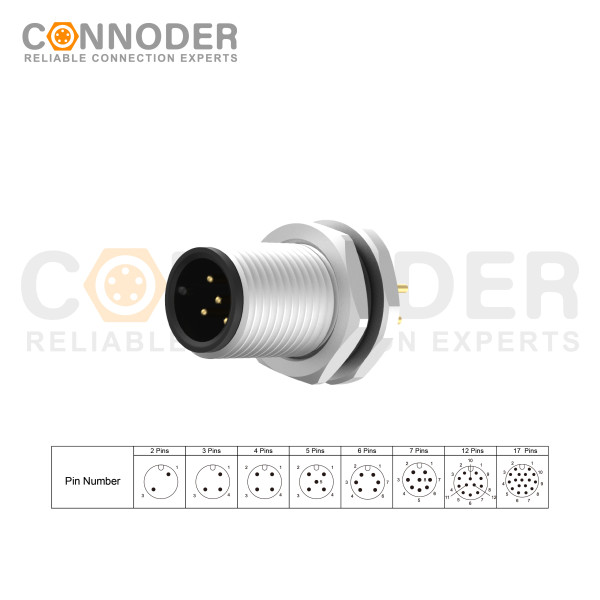
The M12 A 5 Pin Circular Connector is a standard connector widely used in the field of industrial automation.
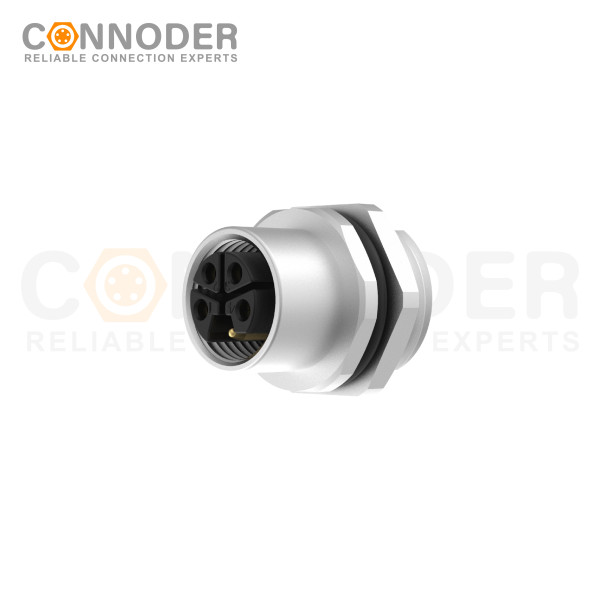
M12 L Coded 4+PE Circular Connector is a metric circular connector used in industrial automation and other harsh environments.