













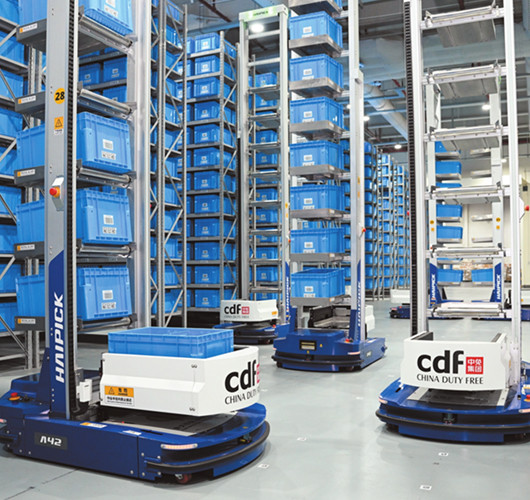
The material and design features that affect the durability and performance of connectors
The material and design features that affect the durability and performance of connectors
Introduction
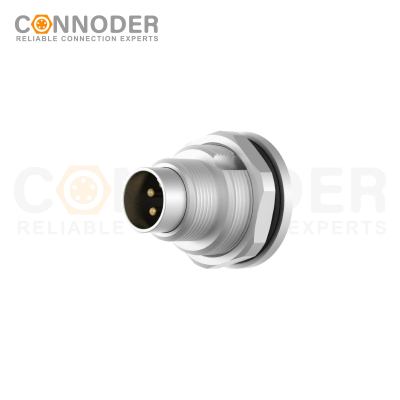
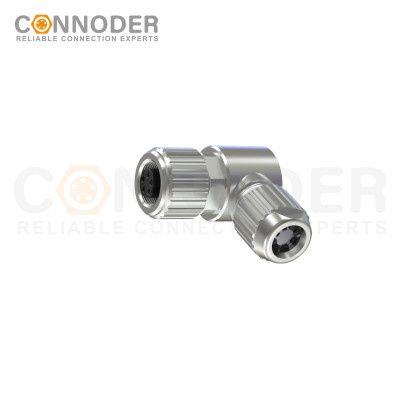
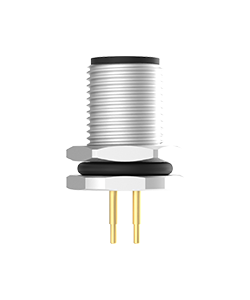
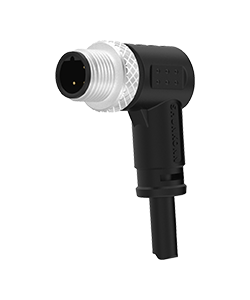
Circular connectors are electrical connectors with a round mating interface, designed to transmit power, signal, or data between devices. Their cylindrical structure enables secure locking, excellent vibration resistance, and long service life, making them suitable for both industrial systems and consumer applications.
For industrial automation, robotics, sensors, control systems and other demanding applications, connector durability is closely related to both material selection and mechanical design. A connector must maintain electrical continuity while also resisting mechanical wear, environmental exposure and repeated stress throughout its service life.
This article examines the key material and design features that affect the durability and performance of connectors, based on established connector engineering principles and practical requirements for harsh industrial environments. It also explains how CONNODER approaches industrial circular connector design and application requirements.
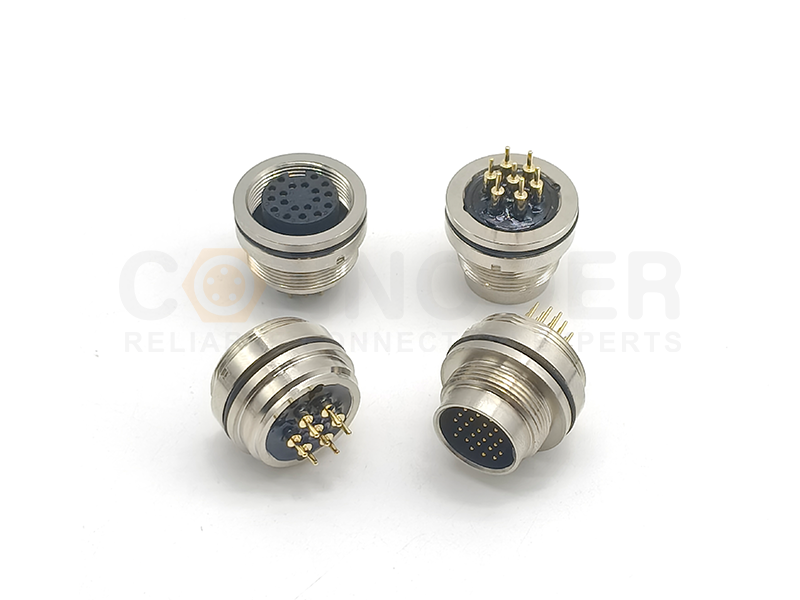
Circular Connectors
Rugged, compact and versatile — ideal when you need mixed power & signal plus environmental protection.
What Determines the Durability of an Electrical Connector?
Connector durability is the ability of a connector to maintain its required mechanical, electrical and environmental performance throughout its expected service life.
A durable connector should continue to provide:
Stable electrical contact
Low and consistent contact resistance
Reliable mechanical coupling
Adequate contact force
Resistance to vibration and shock
Protection against moisture and contaminants
Stable insulation performance
Resistance to corrosion and wear
Reliable performance after repeated mating cycles
Contact Plating Affects Wear, Corrosion and Electrical Stability
Contact plating is another major factor affecting connector durability.
Even if the underlying contact material has excellent mechanical properties, its exposed surface may be vulnerable to:
Oxidation
Corrosion
Fretting
Mechanical wear
Environmental contamination
A suitable plating system creates a protective surface between the contact material and the operating environment.
Common Connector Plating Materials
Depending on the application, connector contacts may use:
Gold
Tin
Silver
Nickel-based layers
Other engineered surface treatments
The choice depends on:
Current requirements
Environmental conditions
Mating cycles
Required contact resistance
Corrosion exposure
Cost and application requirements
Why Plating Thickness Matters
Repeated mating causes sliding contact between surfaces.
During each mating cycle, mechanical friction can gradually wear the contact surface. If the plating is not appropriately designed for the expected number of mating cycles, the underlying material may eventually become exposed.
This is why engineers should evaluate:
Plating material + Plating thickness + Contact force + Mating cycles + Environment
rather than looking at plating material alone.
Contact Geometry Has a Direct Impact on Connector Performance
Material selection alone cannot guarantee long-term reliability.
The geometry of the contact system is equally important.
Contact geometry determines how mechanical forces are distributed when two mating components come together.
Important design parameters include:
Contact shape
Contact area
Engagement length
Contact pressure
Wiping distance
Spring geometry
Alignment
A well-designed contact system should maintain reliable electrical contact without creating unnecessary friction or excessive mechanical stress.
Contact Wipe
During mating, one contact surface may slide across another.
This wiping action can help remove small amounts of contamination from the interface and create a fresh electrical contact area.
However, excessive wiping can increase:
Friction
Insertion force
Surface wear
Plating degradation
Therefore, the objective is not maximum contact movement.
The objective is controlled mechanical interaction that maintains reliable electrical contact while minimizing unnecessary wear.
Housing Material Protects the Internal Connector System
The connector housing provides mechanical support and environmental protection for the contacts.
Depending on the application, housings may be manufactured from engineering polymers or metals such as:
PA-based engineering plastics
Glass-fiber-reinforced polymers
Brass
Stainless steel
Aluminum alloys
Engineering Plastic Housings
Engineering plastics can provide:
Electrical insulation
Low weight
Chemical resistance
Design flexibility
Cost-effective manufacturing
However, the selected material must maintain its dimensional stability within the application's temperature range.
Metal Connector Housings
Metal shells can provide:
High mechanical strength
Impact resistance
Environmental protection
Potential EMI shielding
Improved structural durability
For industrial circular connectors, the housing material should be selected according to the actual operating conditions rather than simply based on appearance or material cost
Locking and Coupling Design Prevents Accidental Disconnection
A connector may have excellent electrical contacts but still fail if the mating mechanism cannot withstand the application's mechanical conditions.
This makes locking and coupling design one of the critical factors affecting connector durability.
Common mechanisms include:
Threaded coupling
Bayonet coupling
Push-pull locking
Latching mechanisms
Secondary locking systems
Threaded Circular Connectors
Threaded coupling is widely used in industrial circular connectors because it provides a secure mechanical connection.
It can be particularly useful in environments exposed to:
Continuous vibration
Mechanical shock
Equipment movement
Cable pulling forces
For industrial automation applications, a reliable coupling mechanism can help maintain the mechanical integrity of the connection throughout equipment operation.
Sealing Design Determines Environmental Durability
Environmental conditions are among the most important factors affecting connector service life.
A connector used inside a clean control cabinet may experience very different conditions from one installed on outdoor machinery.
Potential environmental threats include:
Water
Humidity
Dust
Oil
Chemicals
Salt
Condensation
Industrial fluids
How Sealing Improves Durability
A connector may use:
O-rings
Gaskets
Cable seals
Grommets
Molded sealing structures
Effective sealing helps prevent contaminants from reaching the contact interface.
For industrial applications, engineers should consider the required IP protection level together with:
Operating temperature
Chemical exposure
Cable movement
Installation method
Connector mating condition
IP rating should be treated as one part of the connector selection process, not the only measure of durability.
This is one reason ruggedized connector designs are widely used in transportation, aerospace, defense and industrial automation applications.
How to Select a Durable Connector for Industrial Applications
When selecting a connector, engineers can use the following evaluation process.
Step 1: Define the Electrical Requirements
Identify:
Rated voltage
Rated current
Number of contacts
Signal or power requirements
Contact resistance requirements
Step 2: Define the Mechanical Requirements
Determine:
Mating cycles
Vibration
Mechanical shock
Cable movement
Locking method
Installation space
Step 3: Define the Environmental Conditions
Evaluate:
Temperature
Humidity
Water exposure
Dust
Chemicals
Oils
Salt spray
Outdoor exposure
Step 4: Evaluate Materials and Design
Check:
Contact material
Plating
Housing material
Contact geometry
Contact force
Sealing structure
Strain relief
Step 5: Match the Connector to the Application
Finally, choose a connector family whose specifications and construction match the real operating environment.
This approach is more reliable than choosing a connector solely by price or basic electrical ratings.
Conclusion
A well-designed connector should maintain electrical continuity while resisting mechanical wear, corrosion, vibration, temperature changes and repeated mating throughout its expected service life.
For industrial automation and other demanding applications, engineers should therefore evaluate connector durability from a complete system perspective.
CONNODER provides a range of industrial circular connector solutions, including M5, M8, M9, M12, M16 and 7/8-inch series, helping customers address different industrial connectivity requirements.
If you are evaluating connectors for a new project, equipment upgrade or customized application, learn more about CONNODER's company capabilities and industrial connectivity solutions through the CONNODER About Us page.
What are the core factors affecting connector durability?
They mainly include contact material, plating, contact geometry, contact force, housing material, locking mechanism, sealing structure, strain relief, temperature, vibration, corrosion, and mating cycle count — a system-level outcome of materials engineering + contact engineering + mechanical design + environmental protection.
Why does contact plating affect connector lifespan?
Plating isolates oxidation, corrosion, and fretting wear, maintaining stable contact resistance. However, plating material + thickness + contact force + mating cycles + operating environment must all be evaluated together. Looking only at the plating material is insufficient; repeated mating can wear through the plating and expose the base material.
Is a high IP rating sufficient to guarantee connector durability?
No. IP ratings only address dust and water ingress. Overall durability also depends on contact design, vibration resistance, mating lifespan, temperature performance, and mechanical structure. In environments with excessive vibration, high-IP connectors can still fail prematurely.
How does vibration accelerate connector failure?
Continuous vibration causes micro-displacement at the contact interface, leading to fretting wear, contact resistance fluctuation, and loosening of the locking mechanism. Therefore, high-vibration applications must be paired with reliable screw locking and adequate contact force design.
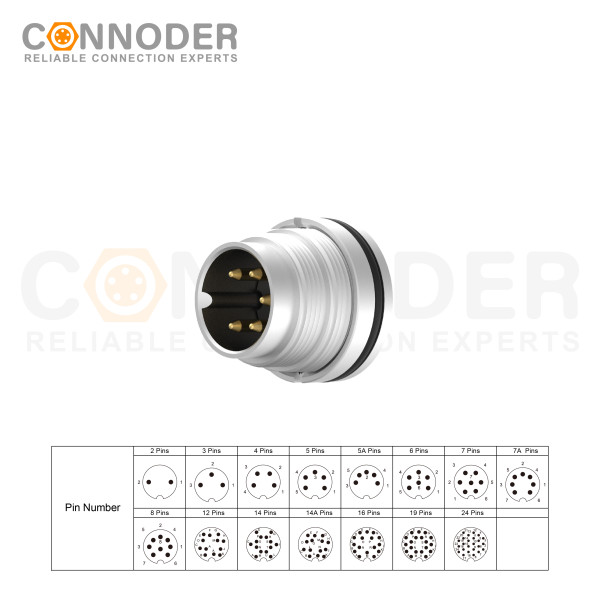
M16 6 Pin Circular Connector A-Code Interface, Waterproof Connector Receptacle Cable, Straight, Front-Locking, Unshielded
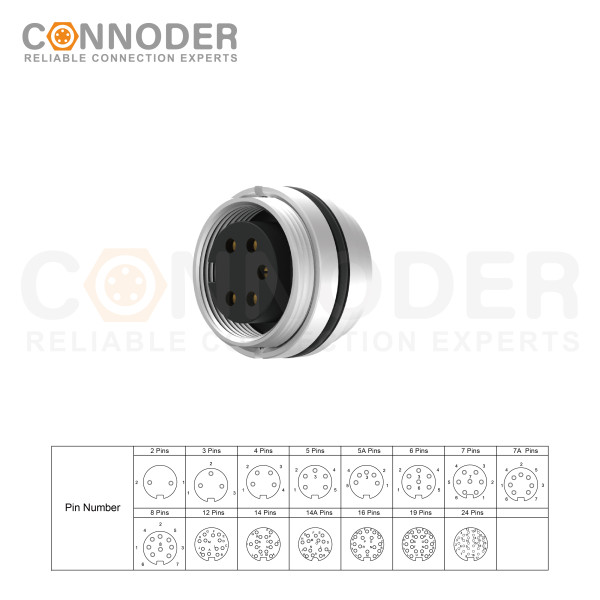
M16 6 Pin Circular Connector assemblies are ideal for demanding industrial applications such as industrial automation and aerospace, marine, and telecom systems.
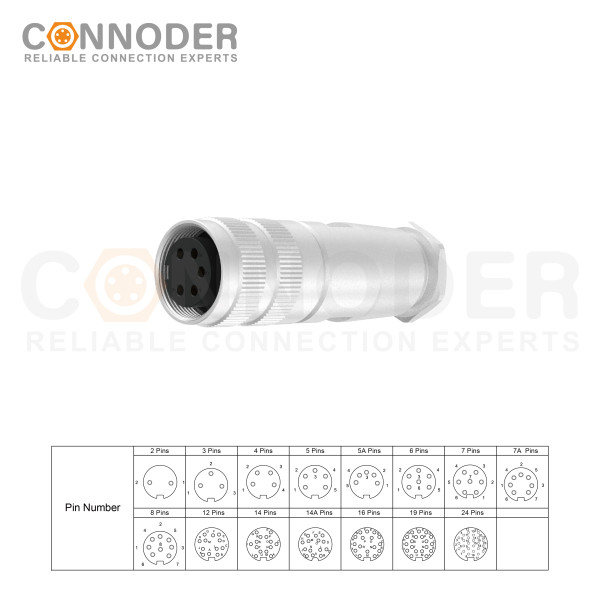
M16 6 Pin Circular Connector are ideal for demanding industrial applications such as industrial automation and aerospace, marine, and telecom systems. M16 Circular Connector are available in quick-lock wiring assembly types with IP67 protection and a vibration-resistant screw design.
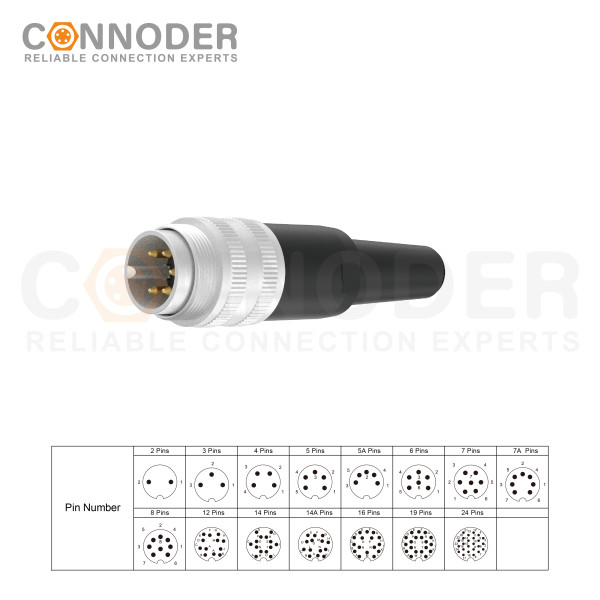
M16 6 Pin Circular Connector are ideal for demanding industrial applications such as industrial automation and aerospace, marine, and telecom systems. M16 Sensor connector are available in quick-lock wiring assembly types with IP67 protection and a vibration-resistant screw design.